Definition and General Scope
Shoubo (手搏) is usually translated as “hand combat” or “hand-to-hand fighting.” According to several scholars who study early Chinese sources, the term appears in classical literature as a broad reference to unarmed fighting. It does not describe a formalized style. Instead, it refers to physical methods used when weapons were lost or unsuitable for the situation.
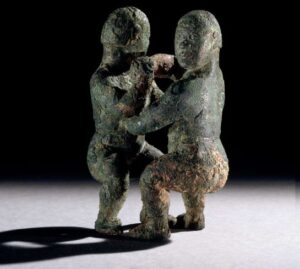
Bronze figures of two wrestlers.
5thC BC-4thC BC (circa).
Made in: China, Possibly from the South.
Researchers such as Ma Mingda and Kang Gewu suggest that Shoubo may have been connected to training practices in early Chinese warfare. However, this interpretation remains tentative, as no technical manuals from the Zhou, Qin, or Han periods explicitly mention Shoubo, and the available evidence is limited to indirect references, archaeological images, and statues.
Early Written References
Several classical works include references to activities that scholars associate with unarmed combat. The Zhouli 1 (Rites of Zhou), compiled during the late Warring States and early Han periods, lists physical contests and training activities for officials. While it does not describe combat methods in technical detail, researchers consider these references significant because they suggest that unarmed physical training was recognized within administrative and military contexts. Importantly, the Zhouli does not explicitly use the term Shoubo to describe these activities; thus, the connection relies on scholarly interpretation.
The Hanshu 2 (Book of Han) also records organized