Before diving into the story of Channan’s Cave, it is important to note that this tale belongs more to folklore than to documented history.
To fully understand the context, readers should first be familiar with the articles on Annan and Chinto. Only then can this story be appreciated as a reflection of cultural memory and storytelling, rather than a literal historical event.
With that in mind, the following article explores the cave, the legendary meeting between Matsumura and the Chinese shipwrecked sailor, and why this story is considered more lore than fact.
Note: The earliest known written reference connected to the Chinese shipwreck appears in a 1914 Okinawan newspaper article by Gichin Funakoshi. In that article, Funakoshi recounts what he had been told by his teacher, Ankō Asato. Funakoshi mentions Matsumura, but it is very likely that this refers to Matsumora from the Tomari area. That issue is addressed in a separate article, which can be read here (Chinto). Nevertheless, this piece of lore is a fun one.
Channan’s Cave
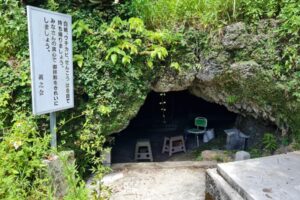
Kami‑nu‑ya Cave (カーミヌヤードウクツ)
In Tomari, Okinawa, there is a small cave near the hillside graveyard known in local tradition as Channan’s cave or by its Okinawan name Kami‑nu‑ya Cave (カーミヌヤードウクツ). Some sources also refer to this cave as Furuherin or Temple of the Fire God.
According to traditional Okinawan oral history, at some point around 1850, a Chinese sailor was shipwrecked near Tomari and took refuge in this cave. In different tellings of the story, he is described as a sailor or sometimes called a pirate. In the traditional account, his name is given variously as Annan, Channan, or possibly Chiang Nan, which may have been his original name.
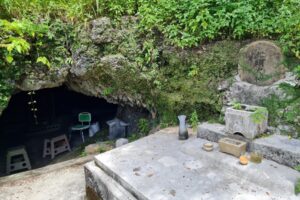
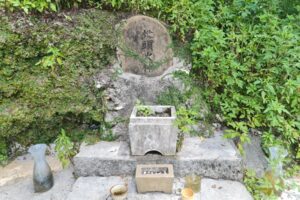
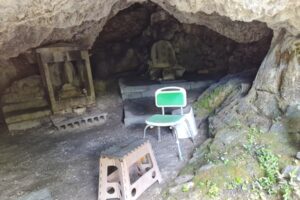
The Story of Matsumura and the Chinese Sailor
Around 1850, a Chinese sailor, some say a pirate, was shipwrecked near Tomari, Okinawa. He hid in a cave located near a graveyard. In order to survive, he stole food and crops from the local villagers.
The Okinawan king, who lived at Shurijo Castle, heard of this and sent Sokon (Bushi) Matsumura, his personal bodyguard, to apprehend the man. Matsumura went to the cave and confronted the sailor.
The two fought. Matsumura was surprised by the man’s speed, strength, and skill. Every attack Matsumura attempted was countered, and the sailor could not overcome Matsumura either. After a prolonged fight, neither man won, and the encounter ended in a draw.
Matsumura then offered the sailor food and clothing. They became friends. In return, the sailor, called Annan or Channan, taught Matsumura his martial techniques, including the kata Chinto.
After some time, the sailor left Okinawa. The cave where he had lived became known in later tradition as Channan’s Cave, and the story was passed down among karate practitioners.
Why This Is Likely Lore
Although the story is engaging, it raises several doubts. Why would the king, based at Shuri, send his personal bodyguard to catch a thief when local staff in Tomari could probably have handled it? It seems improbable that Matsumura went alone, and possibly unarmed, to confront a pirate with bare hands. And a fight around 1850 ending in a draw? A trained royal guard would almost certainly have overpowered a stranger.
The meeting between Matsumura and the sailor reads more like a simplified narrative rather than a historical account. I do not doubt that there may have been a shipwrecked sailor, called Annan or something similar, who took refuge in the cave. The romanticized tale just presented cannot be taken as fact. Nonetheless, it remains a compelling story.
Several written sources cast doubt on the account, suggesting it is more legend than reality. The story survives through oral tradition and illustrates how historical memory and folklore have blended in Okinawan karate history.
Video from Channan’s Cave

Thanks for reading
Gert