Okinawan karate master Chōtoku Kyan preserved pre-modern martial traditions after the Ryūkyū Kingdom’s fall, maintaining a mentorship-based approach while engaging selectively with early modernization efforts.
Okinawa at the End of the Ryūkyū Kingdom
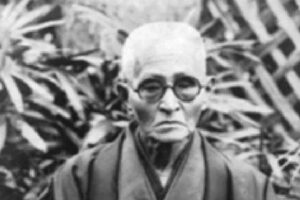
Chōtoku Kyan’s life unfolded entirely in the aftermath of the collapse of the Ryūkyū Kingdom. Born in December 1870 in Gibo Village, Shuri, he entered the world nine years before the formal abolition of the kingdom in 1879 and the establishment of Okinawa Prefecture. This political shift dismantled the court system that had governed Okinawa for centuries and removed the social foundation of families connected to royal administration.
The former court elite, including the Pechin families, lost both income and function. Positions tied to diplomacy, internal governance, and court service ceased to exist. What replaced them was a prefectural structure imposed from mainland Japan, with little regard for Ryūkyū traditions. For children of former court families, this meant growing up without the roles their parents had been trained for.
Karate must be understood within this setting. It was not a public art, nor a profession. It remained a private discipline transmitted quietly among individuals who often had no formal social standing left. Kyan did not inherit a stable system but lived through a period where traditions survived through personal relationships rather than institutions.
His karate cannot be separated from this loss of structure. He was not shaped by modern dojo culture, public education, or national organizations. He belonged to the last generation trained before karate was reorganized for schools and mass instruction. This context explains his preference for personal transmission rather than institutional expansion.
Family Background and Social Class
Chōtoku Kyan was born into a prominent noble family with ties to the Ryūkyū royal court. His father, Chōfu Kyan, was a high-ranking official and a descendant of the royal Shō line. Originally born into the Motonaga family, Chōfu was later adopted into the Kyan lineage to preserve the family name and inheritance. The Kyans belonged to the pechin class, an educated administrative stratum with civil and security responsibilities rather than a standing military caste. Pechin families were expected to be literate, versed in Chinese and Japanese learning, and capable of administrative service. Martial skills existed within this class, but they were not professional soldiers. Family connections linked the Kyan, Motonaga, and Motobu houses.
Oral accounts and later testimony suggest a close relationship between Chōtoku Kyan and Motobu Chōki, often described as cousins. Genealogical examination indicates that while they shared lineage through the Motobu Udun, the exact familial relationship is more complex than simple cousinship. This background placed Kyan within a cultural environment that valued education, discipline, and discretion. It also meant that after the court’s collapse, his family experienced loss of status and security.
Birth, Name, and Lineage Questions
Most Okinawan sources commonly cite December 1870 as the year of Chōtoku Kyan’s birth, usually placing it in Shuri and often mentioning Gibo Village, though precise documentation for the exact date and birthplace remains limited. Variations likely reflect differences between household registration practices and later recollections rather than firm contradictions.
The question of his name is significant. “Kyan Chōtoku” is the name by which he is known in karate history. However, genealogical research and testimony from Motobu family descendants indicate that his original household affiliation was Motonaga, reflecting his father’s lineage before adoption into the Kyan family. Such changes were normal within Ryūkyū aristocratic society and followed established practices of household succession.
Later karate writings often treated “Kyan” as a fixed family identity without addressing adoption or lineage shifts. Research has clarified that these transitions were administrative and social, not unusual or secretive.
Understanding these naming issues is important for separating documented lineage from later narrative simplification.
Father Chōfu Kyan: Education, Court Service, and Influence

Chōfu Kyan was an educated court official during the final years of the Ryūkyū Kingdom. Surviving records confirm his service within the court administration and his status within the educated pechin class. He served under Shō Tai, the last king of the Ryūkyū Kingdom, and was responsible for safeguarding the royal hanko (official seal). He was educated in ancient Japanese and Chinese culture and regarded as a scholar-warrior, trained in both intellectual and fighting traditions.
After the abolition of the Ryūkyū Kingdom, the Kyan family lost formal social standing and court-related roles, leaving them in a socially precarious position. While Chōfu Kyan retained personal connections with members of the former royal household, these were informal and did not restore the family’s official status. Thus, Kyan grew up in a household shaped by former prestige but facing real social and economic limitations.
Chōfu’s education would have included Chinese classics, administrative practice, and court etiquette. This background strongly suggests that his household valued learning and discipline. In his 1942 autobiographical article, Chōtoku Kyan states that he began learning karate from his father, and continued training with him for many years, possibly longer than with any other instructor. While the structure of this instruction is unclear, it indicates that Chōfu was likely his most sustained martial influence.
Chōfu influenced Chōtoku’s upbringing through education, physical cultivation, and cultural continuity during a period of social collapse.
Childhood Health and Physical Limitations
Chōtoku Kyan is consistently described as small and frail during his childhood. While oral tradition across multiple lineages refers to asthma, frequent illness, and weak eyesight, Nagamine only notes that Kyan was physically smaller and weaker than his father. These accounts provide context for his nickname “Chan Migwa”, often translated as “squinty-eyed Chan”.
Such physical traits are not trivial details; they help explain both his training focus and his later technical characteristics. Rather than relying on strength or size, Kyan developed a methodology emphasizing timing, angles, and precision. His karate did not aim to overpower, but rather to disrupt balance, target vulnerable areas, and exit quickly, an approach born from the necessity of someone who could not rely on physical dominance. Furthermore, these limitations may explain his legendary persistence. In a society that valued resilience, overcoming childhood infirmity carried significant social weight. Ultimately, his later reputation as a formidable fighter contrasts sharply with these early descriptions, which serve to reinforce the credibility of the accounts rather than diminish them.
Education and Possible Time in Tokyo
Various Okinawan sources, notably Nisaburo Miki’s 1929 interview with Kyan, indicate that he received a formal education in Chinese classics, a standard practice among the pechin class. He likely spent part of his adolescence in Tokyo accompanying his father, Chōfu Kyan, who served the deposed King Shō Tai. According to Shōshin Nagamine, Chōtoku Kyan lived in Tokyo from age twelve to sixteen. Kyan studied Kangaku (漢学, Chinese philosophy) at Nishōgakusha during these four years while training diligently in karate and jujutsu. This exposure to Chinese literature and moral philosophy likely influenced Kyan’s later emphasis on restraint and discipline, suggesting his karate was shaped by intellectual scholarship as much as physical training.
Other sources, notably research compiled by Motobu Naoki, provide a slightly different perspective. In his 1942 autobiographical article “Memories of Karate”, Kyan wrote that he began learning karate from his father at age fifteen and accompanied him to Tokyo, remaining there until he returned to Okinawa at age twenty-six. This account suggests roughly eleven years of training in Tokyo under his father’s guidance. However, this timeline may conflict with the period during which Kyan practiced with Kosaku Matsumora, as the maximal time he could have trained with Matsumora would likely have been only one to two years. Nevertheless, both statements may be possible and truthful.
Early Physical Training: Wrestling and Conditioning
Before advanced karate instruction, Chōtoku Kyan is widely said to have engaged in wrestling, generally identified as tegumi. Tegumi was common among Okinawan youth and served as both play and conditioning. It emphasized balance, gripping, and body awareness.
Oral accounts suggest that wrestling was used deliberately to strengthen Kyan’s weak body. This aligns with contemporary practices and does not require speculative assumptions. Tegumi would have provided practical experience in close contact, which later influenced his karate.
There is no evidence that this training was formalized or institutional. It was likely informal, repetitive, and integrated into daily life. This type of conditioning fits the period and social class.
Understanding this background helps explain Kyan’s comfort at close distance and his emphasis on entering rather than retreating. Wrestling experience supports efficient movement and control rather than extended exchanges.
Karate Training Environment in Shuri and Tomari
During Kyan’s formative years, karate was not taught in a public dojo. Instruction occurred privately within homes or courtyards, often in very small groups. Training emphasized kata, paired work, and direct personal correction rather than standardized curricula.
Shuri and Tomari represented overlapping but distinct environments. Shuri-te remained connected to former court circles, while Tomari-te reflected a village-based tradition with different emphases. Instruction was selective, informal, and shaped by personal relationships rather than institutions.
Teachers Attributed to Chōtoku Kyan
Chōtoku Kyan is associated with several senior figures in Shuri and Tomari karate. Oral accounts state that in his mid-teens, possibly around 1886, after returning from Tokyo, he began studying under Sōkon Matsumura, learning kata such as Gojūshiho and Seisan for about two years. Matsumura is often cited as one of Kyan’s earliest external teachers, though the contact appears to have been relatively brief.
Kōkan Oyadomari, who lived until 1905, is credited with teaching Kyan kata, including Passai. Many sources indicate that Kyan trained under Oyadomari for approximately four to six years. Some sources also mention Yasutsune Azato, though this is considered a possible rather than confirmed contact.
Chōtoku Kyan may have studied briefly with Kosaku Matsumora before the latter’s death in 1898, focusing on kata such as Chintō. However, Nagamine’s account offers a different perspective: he omits Matsumora entirely, stating instead that Kyan studied under Sōkon Matsumura and Itosu Ankō in Shuri, as well as Kōkan Oyadomari in Tomari. Similarly, Nagamine makes no mention of training under Yasutsune Azato, an instructor frequently cited in other biographical accounts.
The origins of some of Chōtoku Kyan’s repertoire require chronological clarification, especially regarding Maeda Pechin1 as a teacher of Wanshū. If we take Shōshin Nagamine as the point of departure, Chōtoku Kyan returned to Okinawa in 1886 at the age of sixteen after his stay in Tokyo. This would have given him approximately three to four years to learn Wanshū from Gichō Maeda (1826–1890) before Maeda’s death. According to Motobu Naoki, however, Kyan returned to Okinawa at the age of twenty-six in 1896, by which time Gichō Maeda had already been deceased for six years. If instead the reference is to Ginin Maeda (1840–1921), both timelines become historically possible. Based on this chronological consideration, it appears most likely that Ginin Maeda was the person who taught Chōtoku Kyan the kata Wanshū.
Similarly, Kyan’s instruction in Kūsankū is subject to varying accounts. While many historians view the connection to Chatan Yara as unverified, Shōshin Nagamine records in his book “Tales of Okinawa’s Great Masters” that Kyan learned the kata from Chatan Yara2. This specific transmission later became a cornerstone of Kyan’s lineage, known in his interpretation as Yara no Kūsankū.
Kyan’s karate training was private and selective, conducted outside any formal institutions. He studied under a network of experienced instructors across Shuri and Tomari, but all instruction was given personally and informally. This ensured that his learning remained mentorship-focused rather than part of any public or standardized system.
Technical Characteristics of Kyan’s Karate
Accounts from multiple Okinawan lineages describe Chōtoku Kyan’s karate as highly efficient and unusually powerful for a man of small stature. A key concept associated with his method is chinkuchi, referring to the harmonious synchronization of mind and body, among other factors, yielding maximum force with minimal effort.
Rather than relying on mass, Kyan generated force through precise timing, brief internal compression, and immediate release. Lineage accounts describe his power as decisive at short range and difficult to anticipate.
Equally characteristic was his use of tenshin, meaning angled entry and body displacement. Kyan did not meet force head-on; he favored diagonal movement and stepping off the line while closing distance. This often included low, horizontal jumps or skipping steps used to enter from an unexpected angle to collapse the opponent’s balance. The combination of chinkuchi and tenshin defined Kyan’s karate: power generated internally and delivered at close range, with footwork creating positional advantage rather than distance.
Kata Associated with Chōtoku Kyan
Certain kata are reliably associated with Kyan across multiple Okinawan lineages, including Chintō, Wanshū, Passai, Kusanku, and Naihanchi. His interpretation of Passai is particularly influential and is often referred to within lineages as Kyan no Passai.
Some traditions also associate this transmission with Yara-related material. While these forms are closely related, they should not be treated as identical without qualification. Differences in naming reflect lineage transmission rather than a single standardized version.
Kyan did not invent these kata, but he played a critical role in preserving and refining their execution. His versions retain complex angles, rapid shifts, and explosive power generation that were often reduced in later school-oriented adaptations.
Teaching Activity and Locations
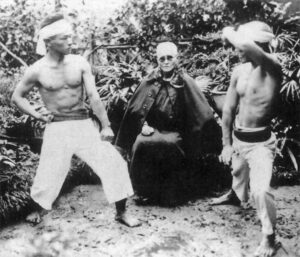
Kyan taught throughout his life. Instruction occurred in homes and later in rural areas, including regions near Kadena (Yara village).
From around 1910 and in the following decades, Kyan provided instruction in karate at the Kadena Police Station. In addition, he occasionally taught at the Okinawa Prefectural Agricultural School. His teaching style favored long-term students. He avoided large groups and public displays. This aligns with broader Okinawan practice before karate’s institutionalization.
Students and Transmission Lines
Three students are consistently documented as the main transmission lines of Kyan’s karate: Zenryō Shimabukuro, Jōen Nakazato, and Tatsuo Shimabuku. None were formal “heirs” in an institutional sense, but each received sustained instruction.
Zenryō Shimabukuro preserved a curriculum regarded within his lineage as closely reflecting Kyan’s personal kata interpretations. Jōen Nakazato emphasized strict technical discipline and preservation within the Shorinji-ryū line. Tatsuo Shimabuku later synthesized Kyan’s foundation with other influences to form Isshin-ryū.
These differences reflect personal development rather than deviation, demonstrating that Kyan transmitted principles rather than a fixed system.
Relationship to Karate Modernization
Kyan did not integrate the Pinan kata into his core curriculum and did not establish a large public dojo system. However, he participated in public demonstrations, taught at police and agricultural institutions, and was present at the 1936 meeting of Okinawan masters that formalized the term “karate”. This does not suggest opposition to modernization, but rather a limited interest in organizational expansion. His teaching remained centered on direct personal transmission rather than large-scale instruction.
Later Life and Economic Conditions
Following the collapse of the pechin class, Kyan lived modestly, often facing economic hardship. According to Nagamine, he relocated to the village of Yomitan, where he supported himself by cultivating silkworms and pulling a cart while continuing his martial training. Despite his family’s history, his prior connections to the former court provided neither financial security nor institutional support.
This economic reality is historically significant. Living outside the former court environment placed Kyan closer to rural and working-class Okinawan life. His circumstances reflect the broader displacement experienced by many former court families rather than a deliberate choice.
Death and Immediate Aftermath
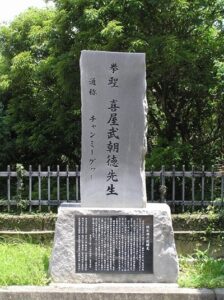
During the Battle of Okinawa, Kyan fled with civilians. He experienced displacement, hunger, and illness.
Chōtoku Kyan died on September 20, 1945, at the age of seventy-six. While the precise effects of the war on his health remain undocumented, Nagamine states that Kyan’s death followed his displacement during the final months of the conflict. It is widely held that he succumbed to illness and exhaustion brought on by the brutal wartime conditions, a tragic fate shared by many on Okinawa at that time.
Posthumous Reputation in Okinawa
Within Okinawa, Kyan is remembered as a serious and skilled practitioner. Some postwar writers describe him as having a colorful and sometimes unconventional personal life, though these portrayals vary and are not consistently supported by Okinawan sources. Memorials and lineage respect reflect quiet recognition rather than public fame.
Legacy in Modern Karate
Kyan’s influence survives through students rather than a named system. His karate persists as a method rather than a brand.
Why Chōtoku Kyan Matters Today
Kyan’s life bridges the transition from court-based martial culture to modern karate practice. His life illustrates how karate survived institutional collapse through individual transmission.
Thanks for reading
Gert
Footnotes
1 Name confusion: During the Ryukyu period, people were often referred to by their titles or village names (e.g. Maeda Pechin). Since both Gicho and Ginin held the title Pechin and belonged to the Maeda family, it is likely that later historians have confused them.
2 This Chatan Yara (c. 1816–1890s), also known as Yara Guwa or Rishin Pechin Yara, was a 19th-century master and a descendant of the original Chatan Yara lineage. According to Shōshin Nagamine, he served as the royal stable superintendent and lived in Yomitan, where he spent several years teaching Chōtoku Kyan the complex Kūsankū kata that now bears the family name.
Share this article