Visiting the monuments of Shōshin Nagamine and Kōsaku Matsumora on a hot day
Tomari Sansaku Michi (Tomari Walking Path)
On our way to visit the monuments of Shōshin Nagamine and Kōsaku Matsumora, we walked along the Tomari Sansaku Michi, which runs from behind Itokazu Hospital to Tomari Elementary School. The path is a historic one-way street in the Tomari district of Naha, Okinawa, closely linked to the development of Okinawan karate.
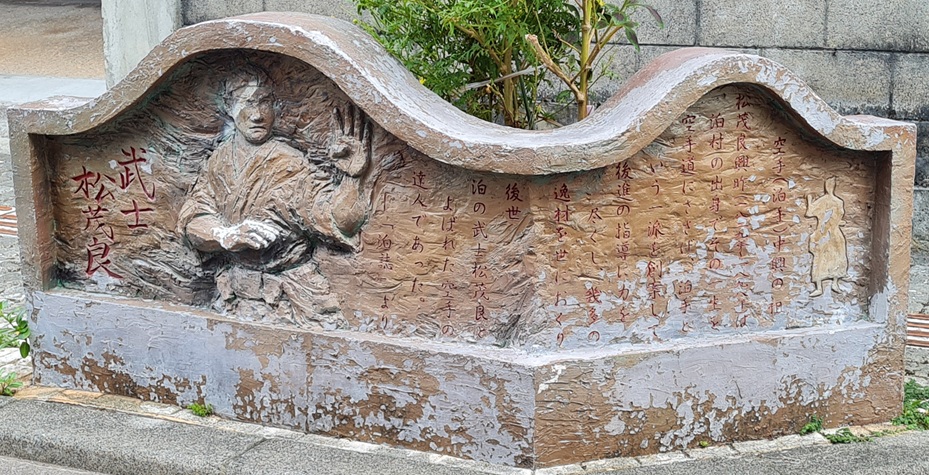
Along the route are several stone relief sculptures dedicated to the history of Tomari-te. Among them, one relief stands out: the stone relief of Kōsaku Matsumora, the well-known martial artist from Tomari.
Kōsaku Matsumora and Tomari-te
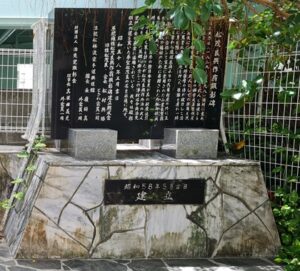
Kōsaku Matsumora (1829-1898) was born in Tomari Village and is regarded as one of the central figures of Tomari-te. He devoted his life to karate and is remembered for preserving and developing the Tomari tradition at a time when the art was still transmitted privately.
Matsumora was known for his strong character, direct approach, and practical understanding of combat. His teaching produced many capable students, and his influence continued through later generations of Okinawan karate.
The monument bears the following inscription:
The rejuvenator of karate (Tomari-te).
Matsumora Kōsaku (1829-1898) was born in Tomari Village. Dedicating his life to karatedō, he invented the school called Tomari-te and strove to instruct his juniors forming numerous outstanding students. For the posterity, he is the karate expert known as Tomari’s “Bushi Matsumora”.
Shōshin Nagamine and Modern Shorin-ryū
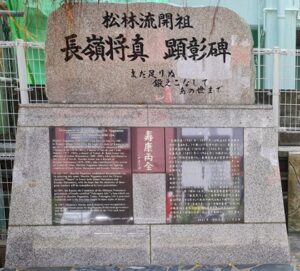
Shōshin Nagamine (1907-1997) represents a later generation, one that worked to organize and document Okinawan karate in the modern era. He is best known as the founder of Matsubayashi-ryū and as an author who recorded historical material that might otherwise have been lost.
Nagamine trained under several teachers connected to the Shuri and Tomari traditions, including Chōtoku Kyan. His karate emphasized natural movement and stability. He also stressed discipline, personal conduct, and responsibility, especially in the training of youth.
Through his books and teaching, Nagamine played an important role in explaining Okinawan karate to a wider audience, both inside and outside Okinawa. His work helped preserve technical lineages, historical accounts, and ethical principles connected to karate practice.
The text on the Shōshin Nagamine monument translates into:
Top row
松林流開祖 (Matsubayashi-ryū Kaiso): Founder of Matsubayashi-ryū.Second row
長嶺将真 顕彰碑 (Nagamine Shōshin Kenshōhi): Commemorative Monument to Shōshin Nagamine.Third row (his famous quote)
まだ足りぬ・鍛えこなして・あの世まで: Still not enough; continue forging yourself through training until the end of life.Breakdown:
まだ足りぬ: Still not enough.
鍛えこなして: Continue forging yourself through training.
あの世まで: Until the end of life.
This quote is a central part of Nagamine’s philosophy and is widely associated with Matsubayashi-ryū training halls.
The Location of the Monuments
One unexpected detail is that they are placed at a playground. Despite this, the location still allows for a moment of pause and reflection.
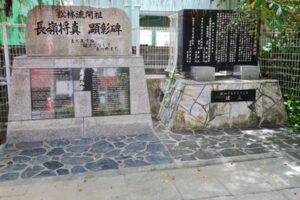
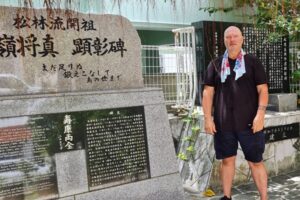
Standing there, it was possible to show respect for the masters and their teachings. The setting may be ordinary, but the monuments’ meaning is not. They mark the continuity of Okinawan karate, from local tradition to modern transmission.
Video

Thanks for reading
Gert