Sanzan Period: Three Kingdoms of Ryukyu
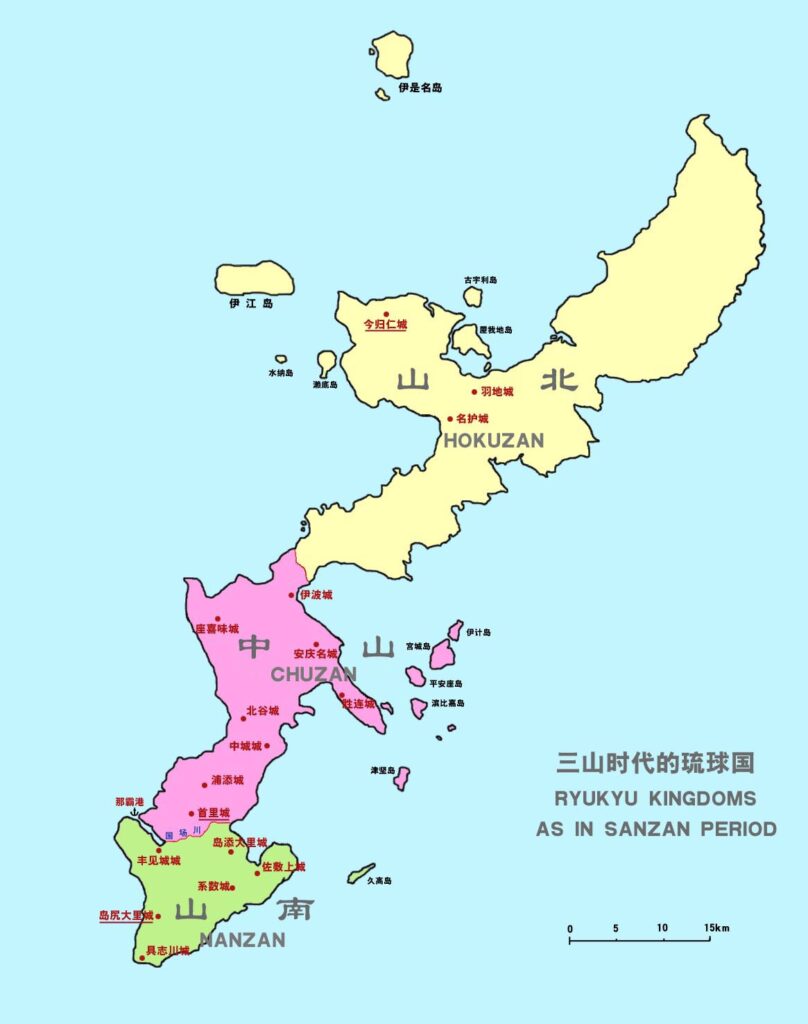
Hokuzan (北山, Northern Mountain)
The northern part of Ryukyu. Existed roughly 1314–1416.
Rulers:
- Haniji (怕尼芝): ca. 1322–1395
- Min (珉): ca. 1396–1400 (some sources say 1402–1403)
- Hananchi (攀安知): ca. 1401–1416
- Hokuzan was overtaken by Shō Hashi (尚巴志) in 1416, ending its independence.
Chūzan (中山, Central Mountain)
The central part of Ryukyu. Politically dominant.
Rulers:
- Tamagusuku (玉城): ca. 1314–1336
- Seii (西威): ca. 1337–1349
- Satto (察度): ca. 1350–1395
- Bunei (武寧): ca. 1396–1406
- Shō Shishō (尚思紹): ca. 1406–1421 (Father of Shō Hashi)
- Chūzan was the base of Shō Hashi, who unified Ryukyu.
Nanzan (南山, Southern Mountain)
The southern part of Ryukyu.
Rulers:
- Ufusato (承察度): ca. 1337–1396
- Oueishi (汪英紫): ca. 1396–1402
- Ououso (汪応祖): ca. 1403–1413
- Tafuchi (達勃期): ca. 1413–1414
- Taromai (他魯毎): ca. 1415–1429
- Nanzan was overtaken by Shō Hashi in 1429.
The fragmentation of the Sanzan era created conditions in which ambitious regional leaders could consolidate power. Among them, Shō Hashi emerged as the architect of political unification.
Shō Hashi (尚巴志)
While many kings inherited thrones, Shō Hashi (1372–1439) consolidated power through calculated military and diplomatic strategy and a vision of a unified archipelago. Originally the son of a local lord in the Chūzan district (Sashiki Magiri), his rise to power marked the definitive end of the chaotic Sanzan period and the birth of the Ryukyu Kingdom as a regional maritime power.
The Rise to Power
Hashi’s journey began in 1406 when he led the campaign that resulted in the replacement of Bunei (武寧) with his father. Rather than taking the throne himself immediately, he placed his father, Shō Shishō (尚思紹), as the figurehead king, establishing the First Shō Dynasty. This allowed Hashi to focus on the military campaigns necessary to bring the rival kingdoms of Hokuzan (北山) and Nanzan (南山) under one banner.
The Conquest of the North and South
Hashi’s military strategy was characterized by speed, precision, and psychological warfare.
Hokuzan (北山, 1416): Nakijin Castle (今帰仁城) made the Northern Mountain appear unconquerable. Hashi combined diplomacy with military operations, securing the support of key Hokuzan officials and conducting a targeted assault. According to Ryukyuan records, this resulted in King Hananchi’s (攀安知) death and brought Hokuzan under his control.
Nanzan (南山, 1429): The final rival, King Taromai (他魯毎) of Nanzan, was brought under Hashi’s authority through a combination of military operations and strategic diplomacy. With Nanzan’s submission, the “Three Mountains” period came to an end, and Hashi became the first ruler of a united Ryukyu Kingdom.
Establishing Shuri as the Royal Heart
Beyond conquest, Shō Hashi (尚巴志) demonstrated exceptional administrative skill. He established Shuri Castle (首里城) as the capital, expanding it into a royal palace that reflected the kingdom’s centralized power. Simultaneously, he expanded Naha Port (那覇港) into a major international trade hub, initiating Ryukyu’s period of maritime prosperity with China, Japan, Korea, and Southeast Asia.
The Ming Dynasty Connection
Under Hashi, the Ming court formally conferred the surname “Shō” (尚) on the royal family, a prestigious recognition that affirmed Ryukyu’s place within the Chinese tributary system. This acknowledgment strengthened diplomatic ties, safeguarded the kingdom, and allowed Ryukyu to serve as a central hub for trade across East Asia.
Unification of Ryukyu
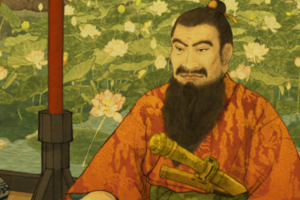
Shō Hashi (尚巴志), originally a lord of Chūzan (中山), conquered Hokuzan (北山) in 1416 and Nanzan (南山) in 1429. This ended the Sanzan period and established the First Shō Dynasty (第一尚氏, 1406–1469).
First Shō Dynasty (第一尚氏, 1406–1469)
- Shō Shishō (尚思紹): 1406–1421
- Shō Hashi (尚巴志): 1422–1439
- Shō Chū (尚忠): 1440–1444
- Shō Shitatsu (尚思達): 1445–1449
- Shō Kinpuku (尚金福): 1450–1453
- Shō Taikyū (尚泰久): 1454–1460
- Shō Toku (尚徳): 1461–1469
Legacy
Shō Hashi (尚巴志) passed away in 1439, having transformed Ryukyu from a collection of rival fiefdoms into a unified, sophisticated state. His combination of military leadership and diplomatic acumen established the foundation for Ryukyuan culture, including architecture, courtly traditions, and international trade, to flourish for generations.
The Transition: From the First to the Second Shō Dynasty
The transition between the two dynasties occurred in 1469 following the death of Shō Toku, the final king of the First Shō Dynasty. His reign had been marked by military expansion but also internal instability and discontent among his officials.
In the wake of Shō Toku’s death, a high-ranking government official named Kanamaru seized power through a coup d’état, supported by the royal court’s elite. Upon ascending the throne in 1470, he took the regal name Shō En.
Despite having no blood relation to the previous line, Shō En chose to retain the surname “Shō”. This was a strategic political move designed to maintain “continuity” in the eyes of the Chinese Ming Emperor. By presenting the transition as a legitimate succession rather than a violent overthrow, the new dynasty ensured that the vital tributary trade relations and diplomatic recognition from China remained uninterrupted. This marked the beginning of the Second Shō Dynasty, which would rule the Ryukyu Kingdom for over 400 years.
Second Shō Dynasty (第二尚氏, 1470–1879)
- Shō En (尚円): 1470–1476
- Shō Sen’i (尚宣威): 1477
- Shō Shin (尚真): 1477–1526
- Shō Sei (尚清): 1527–1555
- Shō Gen (尚元): 1556–1572
- Shō Ei (尚永): 1573–1588
- Shō Nei (尚寧): 1589–1620
- Shō Hō (尚豊): 1621–1640
- Shō Ken (尚賢): 1641–1647
- Shō Shitsu (尚質): 1648–1668
- Shō Tei (尚貞): 1669–1709
- Shō Eki (尚益): 1710–1712
- Shō Kei (尚敬): 1713–1751
- Shō Boku (尚穆): 1752–1794
- Shō On (尚温): 1795–1802
- Shō Sei (尚成): 1803
- Shō Kō (尚灝): 1804–1834
- Shō Iku (尚育): 1835–1847
- Shō Tai (尚泰): 1848–1879, last king before the Japanese annexation of Ryukyu in 1879.
Japanese Annexation of Ryukyu
In 1879, the Empire of Japan formally annexed the Ryukyu Kingdom, forcing the final king, Shō Tai, to abdicate and move to Tokyo. This brought an end to centuries of the kingdom’s independence and dual-tributary status with China. Following the annexation, the islands were officially incorporated into the Japanese state as Okinawa Prefecture.
Cheers, Gert
Share this article