Historical and Legendary Perspectives on Okinawan Karate
Who Was Ason?
Ason is a figure frequently cited in Okinawan martial arts traditions, credited with introducing specific Chinese hand techniques and grappling methods to Okinawa. He is often presented as a Chinese military officer, according to lineage accounts, or a martial-arts master whose instruction influenced early Okinawan practitioners. However, despite his prominence in oral histories and dojo lineage stories, there is no verifiable historical record confirming his existence. His presence in Okinawan karate history exists primarily in the form of legend, anecdote, and the transmitted memory of teachers.
In traditional references, he is sometimes called Ason-dono, with the suffix “-dono” serving as a Japanese honorific indicating respect, similar to “master” or “lord.” This suggests that Okinawan practitioners honored him as a figure of authority, though it does not clarify whether “Ason” was a personal name or a title.
Oral tradition suggests that Ason came from southern China, specifically the Fujian region, and traveled to Okinawa to share his martial knowledge. Beyond these accounts, his birthplace, lineage, or military posting is unknown, and no documents survive that can independently confirm these details.
Historical Context of 17th–19th Century Okinawa
To understand the legend of Ason, it is important to consider the political and social environment of Okinawa during the 1600s–1800s. The Ryukyu Kingdom (1429–1879) functioned as a maritime trading state with strong cultural and commercial ties to China, particularly the Ming and Qing dynasties. These connections facilitated exchanges in many areas, including martial arts.
In the late 15th and early 16th centuries, under King Shō Shin (1477–1526), the Ryukyu government implemented measures to centrally control weapons among civilians. Later, after the Satsuma Domain invaded Okinawa in 1609, additional restrictions limited private possession of arms. These regulations likely encouraged the development of unarmed combat systems, later formalized as Okinawan “Te” and eventually modern karate.
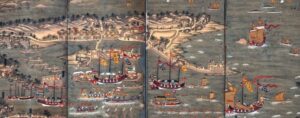
Throughout the 18th and 19th centuries, Okinawan practitioners frequently traveled to southern China or encountered Chinese martial-arts masters through trade and diplomacy. This period saw the emergence of structured kata and the integration of techniques emphasizing hand strikes, stances, and grappling methods. In this environment, it is plausible that Chinese martial arts influenced Okinawan systems. Ason, according to oral tradition, represents the archetype of such a Chinese master transmitting knowledge to Okinawan students.
Influence on Karate
Within oral tradition, Ason is most closely associated with Shōrei-ryū, a style characterized by strong stances, forceful hand techniques, and practical close-range combat. Stories credit him with teaching grips, joint manipulations, and hand strikes, which were then incorporated into early Okinawan kata and training methods.
From a historical standpoint, while the influence of Chinese martial arts on Okinawa is well-documented, the existence of a specific teacher named Ason cannot be confirmed. His association with Shōrei-ryū likely reflects lineage memory, serving as a narrative tool to explain the Chinese elements present in Okinawan kata. Scholars note that many such figures in oral history may represent general influences rather than specific individuals.
Mentions in Historical Accounts
The earliest known references to Ason come from Asato Ankō, an Okinawan master whose accounts were later passed on by Gichin Funakoshi under his pen name “Shōtō.” These references are anecdotal and part of dojo transmission rather than official historical records. Some modern lineage documents mention students such as Sakiyama, Tomoyose, Nagahama, and Gushi Pechin, describing Ason as a teacher of techniques emphasizing strength and close-range combat.
However, no primary documents – neither in Ryukyu records nor Chinese envoy logs – confirm his existence. Other historically documented Okinawan masters, like Higaonna Kanryō, do not mention Ason in their accounts. Therefore, all such references should be categorized as oral or lineage-based tradition, not verified historical fact.
Name, Title, and Linguistic Interpretations
The name “Ason” presents unique interpretive challenges. In Japanese, 朝臣 (Ason) historically denoted a noble rank (kabane) rather than a personal name. Its literal meaning translates roughly as “court minister” or “imperial retainer.” The use of this term in Okinawan tradition suggests that Ason may have been regarded symbolically as a person of authority or high status rather than being a specific individual.
The suffix “-dono” (殿) adds a respectful tone, equivalent to “master” or “lord,” indicating reverence from later Okinawan practitioners. Together, “Ason-dono” may not be a personal name at all, but a designation of rank, status, or respect for a Chinese martial-arts teacher whose real name was unknown or lost.
In Chinese, no historical record confirms a master named “Ason.” Linguistic analysis suggests it could be a phonetic approximation from Southern Chinese dialects, such as 阿孫 (Ā-sūn) or 阿桑 (Ā-sāng), reflecting regional pronunciation. In Korea (Joseon) and Vietnam (Tri Thần), the same kanji denotes aristocratic titles, reinforcing the hypothesis that “Ason” may have been a title, symbolic name, or transliteration, rather than a personal name.
Oral Lineage Accounts
Oral histories credit Ason with teaching early Okinawan students techniques emphasizing grips, hand strikes, and strong stances. Stories passed down through dojo lines describe him as a Chinese officer or master whose instruction shaped the technical foundation of Shōrei-ryū and related kata.
These oral accounts often include anecdotal details – such as specific kata sequences or gripping techniques – that cannot be independently verified. Such recollections may combine memory, symbolic narrative, and technical lineage, reflecting the collective memory of practitioners rather than historical documentation.
Speculative Identity Theories
Several scholars and martial arts researchers have proposed theories regarding who Ason might represent:
- Composite Figure: Ason could symbolize multiple Chinese teachers whose individual identities were lost over generations, merged into a single legendary figure for simplicity.
- Transliteration Hypothesis: The name “Ason” may reflect a phonetic adaptation from Southern Chinese dialects, approximating a real teacher’s name whose exact pronunciation and characters were altered in Okinawan transmission.
- Symbolic Title: Given the kanji 朝臣, Ason might originally have been a title or rank rather than a personal name. Later generations may have misinterpreted this as a proper name, assigning it to a legendary master.
Each theory reinforces that Ason functions as a narrative device explaining Chinese influence in Okinawan martial arts, rather than as a historically verifiable individual.
Historical Facts vs. Oral Tradition
Historically, there are no verified records of Ason in Ryukyu Kingdom archives, Chinese envoy logs, or contemporaneous documentation. Scholars studying the origins of karate note only the general process of cultural exchange between China and Okinawa, rather than any specific Chinese instructor teaching in Okinawa.
Oral tradition fills this gap, preserving a symbolic memory of Chinese influence. Stories of Ason link Okinawan techniques to their Chinese counterparts, emphasizing the perceived robustness, strength, and practical application of these methods.
Political conditions – including weapon restrictions under King Shō Shin and later Satsuma control – contributed to the development of unarmed combat systems. These circumstances created a fertile environment for the adoption of Chinese techniques, making the legend of Ason plausible in context, even if unverifiable.
Students of Ason in Oral and Lineage Traditions
The last part of Ason’s story concerns the question of who trained under him during his time in Okinawa. No historical records confirm the names of any students, and no Ryukyu government documents, envoy logs, or Chinese travel reports list an instructor named Ason working with local practitioners. Because of this, the list of students belongs to oral transmission, not to documented history.
Within Okinawan lineage traditions, several names appear again and again. These names are part of older dojo charts and lineages that try to explain how certain hand methods and gripping skills entered Naha and Tomari. These charts link Ason to a small group of Okinawan practitioners who later taught other well-known figures. While these claims cannot be confirmed, they give insight into how early karate families tried to preserve memories of foreign influence.
The most common name in these lists is Sakiyama, often written as Izumizaki-no-Sakiyama. Some traditions say he learned from Ason and later taught Tomigusuku Uekata, a member of a high-ranking Ryukyu family. Tomigusuku Uekata is a documented official in Ryukyu history, but no existing records describe him as a martial artist, and there is no direct evidence that he trained under Sakiyama.
Nagahama also appears in some oral accounts. The information connected to him is limited, and no historical documents link this name to martial arts practice or to a connection with Ason. He appears only in lineage stories that describe early Naha-te influences.
Another name linked to Ason is Tomoyose. Some lineages use a different spelling, Tomoyori, which may be an older or mistaken transcription. This kind of variation is common in Okinawan family names recorded by later generations. Tomoyose is described as one of the men who learned Chinese hand methods from Ason, but as with the others, no archival records confirm this.
Gushi Pechin is also listed in lineage stories. The title “Pechin” refers to a middle-ranking Ryukyu class that often handled administrative and guard duties. According to oral tradition, Gushi Pechin studied under Ason and later taught Ishimine of Gibo. Ishimine appears in some Tomari-te family traditions, but his life is not documented outside martial arts stories.
These names form a simple but unverified chain:
Ason → Sakiyama / Nagahama / Tomoyose / Gushi Pechin → later Okinawan students.
There are also claims that some Tomari practitioners were trained under Ason, but these names are not recorded, and the statements remain vague. They show that several communities believed their methods had Chinese roots, even when details were unclear.
All of these claims share two points. First, they come from oral or lineage tradition rather than verified historical evidence. Second, they point to a belief that Ason’s teaching helped shape early gripping, seizing, and short-range hand techniques in Okinawa. Whether Ason taught these men or not, their appearance in the stories shows how important Chinese contact became in the identity of local martial arts. The list of students illustrates how later generations understood their heritage and how they tried to keep older knowledge alive.
If future research discovers new archival material, these lineages may change. For now, the student list remains an example of how Okinawan martial arts preserved memory through oral transmission rather than written history.
Conclusion
Ason remains a figure at the intersection of legend and martial arts memory. While he cannot currently be identified as a historical individual, the stories associated with him illustrate the broader Chinese influence on Okinawan karate. He may represent a real teacher, multiple individuals, or a symbolic figure embodying Chinese martial arts principles introduced to Okinawa.
His enduring presence in oral tradition and lineage charts highlights the importance of cultural memory in martial arts. Ason serves as a bridge connecting Chinese and Okinawan traditions, providing context for the techniques, grips, and stances that define early Shōrei-ryū and the development of karate. Recognizing the distinction between documented history and oral tradition allows scholars and practitioners to appreciate both the technical evolution and the cultural narrative embedded in Okinawan martial arts.
Thanks for reading
Gert