History, Transmission, and Technical Identity of the Classical Okinawan Kata Chinto
Chinto is one of the most distinctive and technically demanding kata in Okinawan karate. Its unusual movement patterns, focus on balance, and complex transmission history make it a key form across multiple styles. Chinto is practiced in both Tomari-Te and Shuri-Te-based systems, including Matsubayashi-Ryu, Shorin-Ryu, Shorinji-Ryu, Shito-Ryu, Shotokan, Wado-Ryu, and Isshin-Ryu.
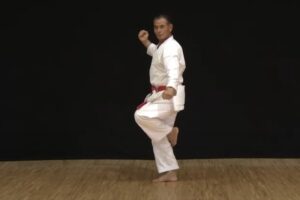
The name Chinto is, according to oral tradition, commonly translated as “fighter to the east” or “battle to the east” and is traditionally linked to a legendary Chinese figure. In Shotokan, the kata is known as Gankaku, a name that refers to the repeated one-legged stances that characterize the form. This renaming reflects a shift in emphasis from historical origin to visible technical features as karate was introduced to mainland Japan.
Early Sources and Oral Tradition
There are no surviving nineteenth-century records that document Chinto as a named kata. What is known about its origin comes primarily from oral tradition and early twentieth-century writings by Okinawan teachers and their students. These sources reflect memories of events that occurred decades earlier and must therefore be treated cautiously.
One of the earliest written references to Chinto appears in a 1914 newspaper article published as Martial Arts of Okinawa in the Ryukyu Shimpo newspaper by Gichin Funakoshi, based on what his teacher, Anko Asato, had told him. In this account, Funakoshi relates an oral tradition concerning a Chinese castaway, referred to as Annan, who is said to have transmitted martial methods to Okinawan practitioners. Funakoshi notes that this teaching was received by several individuals, including a person identified only as “Matsumura.” According to the account, different kata, among them Chinto, Chinte, Ji’in, and Jitte, were learned by different students because the teacher did not remain in Okinawa for long.
This source also illustrates a common problem in karate historiography: later writers often relied on remembered names and informal references. Funakoshi’s account refers to a “Matsumura” as one of the figures associated with this transmission. Because the name was recorded decades after the events and without further detail, later readers often assumed this meant Sokon Matsumura of Shuri. Modern historians generally consider this unlikely. The kata Chinto is consistently linked to the Tomari tradition, and the Matsumura in question is far more plausibly Kosaku Matsumora of Tomari.
Kata transmission from Annan
-
- Gusukuma and Kanagusuku (Kinjo of Tomari) learned Chinto.
- Matsumora and Kokan Oyadomari learned Chinte.
- Gikei Yamasato learned Ji’in.
- Nakasato Kanenobu learned Jitte.
Tomari and Shuri Context
Chinto was practiced in both Tomari and Shuri before karate became formally organized in the twentieth century. Tomari was a seaport community where martial practice developed in close connection with local security and fighting traditions. Shuri, as the royal capital, was home to court-connected instructors and palace guards. Despite their differences, the two communities shared kata and technical knowledge.
Most historical accounts describe Chinto as originating in Tomari-te and later spreading into Shuri-te. Versions associated with Tomari tend to feature more lateral movement and complex footwork. Versions that passed through Shuri teachers, particularly those later adapted by Anko Itosu (1831–1915), emphasize clearer forward and backward movement and a more standardized structure.
Technical Characteristics
Chinto is technically demanding. The kata includes frequent changes of direction, transitions between low and high positions, and repeated one-legged stances that require precise balance and timing. These stances often serve as preparation for kicks or strikes and are central to the kata’s identity.
The footwork is less linear than in many other kata, and the embusen can appear irregular when compared to more symmetrical forms. Because of these demands, Chinto is traditionally taught at an advanced stage of training. Mastery of balance, control, and coordination is considered essential before attempting the kata.
Lineage and Transmission
Kosaku Matsumora (1829–1898) is one of the most consistently cited early teachers of Chinto. A leading figure in Tomari, Matsumora studied under Karyu Uku and Kishin Teruya and is recorded as having passed Chinto to Chotoku Kyan. Kyan later became one of the most influential karate teachers of his generation and transmitted the kata to students who shaped several Okinawan styles.
Kokan Oyadomari (1827 – 1905), another Tomari master, is also associated with the preservation and spread of kata in that community. As with most karate history from this period, transmission occurred through long-term personal instruction rather than written records, making precise timelines difficult to establish.
Anko Itosu played a decisive role in Chinto’s later development. In karate tradition, he is often described as having received Chinto through the Tomari lineage and adapted it for school instruction. Itosu adapted the form as part of his broader effort to systematize karate for group instruction and school education. His version emphasized clarity of structure and was instrumental in introducing the kata to a wider audience.
When Gichin Funakoshi brought karate to Japan, he adopted Itosu’s version and renamed the kata Gankaku. The kata was adapted with certain techniques modified and the embusen adjusted to better fit the Shotokan curriculum. These changes reflect the broader process of adaptation that occurred as karate moved beyond Okinawa.
Tomari Lineage (Matsumora Line):
- Kosaku Matsumora (1829–1898): Practiced Chinte and exchanged kata with Gusukuma, who learned Chinto from Annan.
- Kotatsu Iha (1873–1928): Learned Chinto from Matsumora; taught Shoshin Nagamine.
- Chotoku Kyan (1870–1945): Learned Chinto from Matsumora; taught Zenryo Shimabukuro (Seibukan), Joen Nakazato (Shorinji-Ryu), and Tatsuo Shimabuku (Isshin-Ryu).
Shuri Lineage (Itosu Line):
- Gusukuma Kanagusuku: Learned Chinto from Annan.
- Anko Itosu: Learned Chinto from Gusukuma.
- Itosu’s students include Choshin Chibana, Gichin Funakoshi, Kenwa Mabuni, and others.
- Funakoshi adopted Itosu’s version and renamed it Gankaku in Japan.
The Annan Narrative
The story of the Chinese castaway known as Annan remains one of the most debated aspects of Chinto’s history. Oral accounts describe him as a sailor who survived a shipwreck and briefly taught martial methods to a small number of Okinawan practitioners. Some versions link him directly to Sokon Matsumura, while others associate him more closely with Tomari teachers.
No contemporary records confirm these stories, but the consistency across oral accounts suggests a brief presence, transmitted onward by Okinawan teachers. The earliest written references appear decades later and rely on memory rather than documentation. As a result, historians treat the Annan narrative as oral tradition rather than established fact. What is generally accepted is that any Chinese influence would have been brief and transmitted onward by Okinawan teachers themselves.
Variations Across Styles
Different karate systems preserve distinct versions of Chinto. Matsubayashi ryu retains a form associated with the Kyan lineage, featuring diagonal movement and complex footwork. Versions descending from Itosu tend to emphasize forward and backward movement and clearer segmentation of techniques.
In Shito ryu, the kata may be referred to as Tomari no Chinto, Kyan no Chinto, or Gusukuma no Chinto, reflecting different lines of transmission. Some researchers identify three broad families of the kata, distinguished by embusen and emphasis rather than by technique alone.
Concluding word
No single nineteenth-century source defines an original version of Chinto. What exists instead are multiple lines of oral transmission supported by later written accounts. These sources agree that the kata was widely known in Okinawa before karate became public and that it reflects both local development and Chinese influence.
Today, Chinto remains a core advanced kata, offering insight into the preservation, adaptation, and transmission of Okinawan karate across generations.
Thanks for reading
Gert