How to Adapt Classic Karate Techniques to Realistic Self-Defense Situations
Karate, a martial art with deep roots in tradition and discipline, is often associated with its iconic stances, punches, and kicks. While these techniques work well in controlled environments, adapting them for real-world self-defense requires adjustments. In a self-defense situation, you are dealing with unpredictable, high-stress conditions that demand quick, decisive action. This article explains how classic Karate techniques can be adjusted for real-life self-defense.
Understanding the Nature of Self-Defense
Realistic self-defense is different from the sparring or kata practiced in Karate. It involves reacting to an immediate threat, often in an unpredictable environment. In a self-defense situation, you may encounter an assailant who is larger, stronger, or more aggressive than you. The focus should shift from the traditional discipline of Karate to practical, efficient techniques that help you protect yourself and escape unharmed.
The Importance of Awareness
Awareness is crucial in self-defense, especially when adapting Karate techniques. Recognizing threats early can help you avoid danger altogether. In Karate, you are taught to be aware of your surroundings and to stay alert at all times. This principle remains vital in self-defense, as it allows you to assess the situation and react accordingly. Whether it’s identifying an attacker’s body language or noticing an escape route, awareness plays a critical role in adapting your techniques.
Adapting Karate Strikes for Self-Defense
In a real-world self-defense situation, you need to strike quickly and with purpose. Classic Karate strikes like Kizami-zuki (jab punch) and Gyaku-zuki (reverse punch) are effective when adapted properly. However, they must be modified to ensure maximum impact and minimize wasted movement.
Kizami-zuki and Gyaku-zuki
Both of these punches are often used in Karate kata, and they can be effective for self-defense if you keep a few key principles in mind:
- Speed and Accuracy: A quick jab or reverse punch can distract the attacker enough to break their focus. Aim for vulnerable areas like the eyes, throat, or solar plexus to disable your attacker temporarily.
- Practical Execution: In self-defense, you may not always have the time to execute a perfect form as seen in kata. Therefore, the focus should be on targeting vital areas and delivering the punch with power, rather than relying on the classic stances or form.
Kage-zuki and Gyaku Ura-zuki
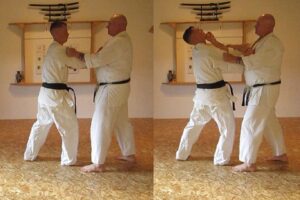
These strikes, which are often used in traditional Karate, are particularly useful in self-defense. The Kage-zuki (hook punch) and Gyaku Ura-zuki (reverse uppercut punch) can be adapted to target an opponent’s blind spots or areas that are not typically protected during a confrontation.
- Hook Punch (Kage-zuki): This punch can be used when an attacker is close to you, perhaps trying to grapple or control your arm. By delivering a swift hook punch to their jaw or temple, you create a moment of distraction, allowing you to escape.
- Reverse uppercut (Gyaku Ura-zuki): This strike is highly effective when you are close to your opponent or engaged in a clinch. It can target sensitive areas like the nose, jaw, solar plexus, or eyes, which may disorient the attacker and give you a chance to break free.
Kicks in Self-Defense: Practical Applications
In Karate, kicks like the Mae-geri (front kick) and Mae-ashi Mae-geri (kick with the front leg) are integral parts of training. When used correctly, they can be powerful tools in a self-defense situation. However, their execution must be adjusted for the realities of a fast-paced, close-range encounter.
Front Kick (Mae-geri)
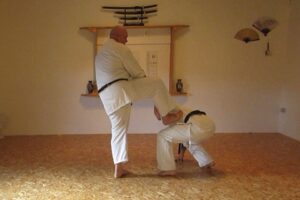
The Mae-geri is one of the most widely used kicks in Karate. When confronted with an attacker advancing toward you, a well-timed front kick can target the midsection or groin, effectively neutralizing the threat. This makes the Mae-geri a versatile technique, useful both offensively and defensively.
- Execution: Instead of performing the kick with perfect form, focus on delivering it quickly and directly. The goal is to strike with the ball of the foot or the heel of the foot, aiming for soft, vulnerable areas.
- Follow-up: After the kick, immediately follow up with another strike or attempt to disengage. This will prevent the attacker from regaining control.
Front Leg Kick (Mae-ashi Mae-geri)
The Mae-ashi Mae-geri involves a front kick with the front leg, which can be highly effective if the attacker is close to you. This kick adds an element of surprise and can be used to create space and maintain distance from the opponent.
Combining Karate Techniques with Practical Self-Defense Moves
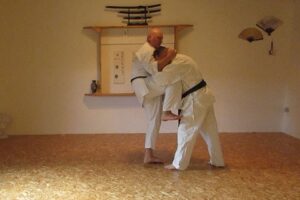
While individual Karate techniques are valuable, combining them with other self-defense strategies increases their effectiveness. Here are a few combinations to consider:
- Strike and Escape: If an attacker moves in, strike with a quick Kizami-zuki to their face or throat, followed by a front kick to their stomach or groin. Immediately use the opportunity to create space and escape.
- Defensive and Offensive: If the attacker throws a punch, use a blocking technique such as a Uke-waza (Block/Receiving technique), followed by a Gyaku-zuki to the face. This combination not only defends against the incoming strike but also counters with a strong punch.
- Grappling Defense: If an attacker tries to grab or hold you, apply a quick Gyaku Ura-zuki to their jaw, followed by a Mae-geri to push them away.
Incorporating Practical Stance Adaptations
Traditional Karate stances, like Zenkutsu-dachi (front stance) and Kiba-dachi (horse stance), are vital for maintaining balance and power in Kata. However, in a self-defense scenario, these stances need to be adjusted for mobility and ease of escape. In real life, the ability to move quickly and fluidly is essential.
- Shifting Weight: Rather than relying on static stances, focus on shifting your weight quickly to respond to attacks and create counterattacks.
- Natural Posture: Avoid being rigid in self-defense. A relaxed stance allows you to move freely, whether to strike or escape.
Adapting classic Karate techniques to real-world self-defense situations requires flexibility and practical thinking. The key is to retain the power, speed, and precision that Karate emphasizes, but to modify them for real-life application. Focus on targeting vulnerable areas, maintaining mobility, and combining techniques for quick, decisive action. Above all, remember that self-defense is not about winning a fight – it’s about protecting yourself and escaping unharmed. Integrating traditional Karate training with practical self-defense strategies can increase your ability to respond effectively in a dangerous situation.
The Illustrations are from my book Okinawan Karate: Practical applications of the Naihanchi Kata.
Thanks for reading.
Cheers, Gert