From Martial Arts to Martial Sport
In many dojos, karate has shifted from a martial art focused on self-defense to a discipline centered on personal growth. Students are often encouraged to see training as a way to build character, demonstrate discipline, and develop inner strength. While these qualities are valuable, this evolution has, over time, somewhat overshadowed karate’s original purpose: self-protection. The focus on character development and inner virtues, although beneficial, can sometimes detract from the practical skills needed to defend oneself effectively in real-world situations.
As karate spread beyond Okinawa, it was reshaped to fit cultural and institutional needs. In Japan, it was adapted for schools. Later, it became a competitive sport. This transformation changed how techniques were practiced and understood. Instead of preparing for violence, karate became a way to win medals or improve oneself through rigid, structured movements. The brutal effectiveness of close-range self-defense was pushed aside.
Competition vs. Conflict
Sport karate emphasizes safety, fairness, and mutual respect through its structured rules and agreements. Competitors consent to the regulations governing targeting, contact levels, and scoring, ensuring that the sport remains disciplined and enjoyable for all participants. The presence of referees, timers, and clear criteria helps maintain integrity and clarity, making sport karate a disciplined and respectful martial art competition.
Real violence is unpredictable and unregulated. It can strike without warning, with no rules, no agreements, and often with overwhelming odds. Unlike sport karate, there’s no referee to stop the action, no scoring system, and no safety measures. In real situations, you might be ambushed, outnumbered, or injured before you even have a chance to defend yourself. Light punches and kicks used in sport don’t fully prepare someone for the sudden, brutal reality of real violence. To be truly prepared, one must incorporate realistic training that mimics these unpredictable and dangerous scenarios.
Many karate schools adopt training that reflects sport values. They drill attacks from long range, assume unrealistic stances, or expect the opponent to react in predictable ways. But self-defense doesn’t follow a script.
Karate Can Be Taught for Self-Defense
Every style can be adapted for real self-defense; it’s not about the style itself, but how it’s taught. When instructors understand violence, pressure, and human behavior, they can transform even the most formal techniques into practical, effective tools.
If not, students are left with moves that look good in the dojo but fall apart under pressure. The same kata can be either a blueprint for survival or just a movement drill.
The difference lies in:
- How you interpret kata.
- How you train under pressure.
- Whether your partner resists.
- If scenarios match real-life aggression.
Bunkai Without Reality Is Useless
Kata is often interpreted through bunkai, which are the applications of its movements. In many schools, however, this is practiced like theater. One person attacks, the other responds with a perfect counter, and then they reset. There is little to no struggle or resistance involved.
It is possible to train bunkai in a more realistic way. You can gradually add resistance and unpredictable attacks while still working in a controlled environment to avoid injuries. If you want to train with even more resistance and unpredictability, protective gear can be used so you can push a bit harder without getting hurt. This allows for more realistic practice and better preparation for real situations.
When kata is only practiced as theater, it can lead to a false sense of confidence. A real attacker will not stand still or throw punches from three steps away. Instead, they will grab, push, or swing wildly at you. That is why it is important to train in a realistic way with appropriate resistance to be truly prepared.
For bunkai to be useful, it must include:
- Close-range grabs, strikes, and clinches.
- Unpredictable reactions.
- Resistance and follow-up attacks.
- Transitions to takedowns or escapes.
Kata was never intended as a solo demonstration; it was a memory aid for close-quarters techniques. When studied through that lens, it becomes a source of practical knowledge.
Hands Up – Open Palms
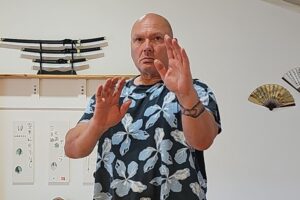
One of the most useful postures in self-defense is the open-hand position. It’s not part of most sports stances. But it’s essential in reality.
Standing with open hands shows the attacker and bystanders that you don’t want to fight; it’s a calming signal. But it also gives you tactical options. With open hands, you can:
- Parry or block.
- Grab clothes or limbs.
- Strike the face or neck.
- Attack the eyes, nose, or throat.
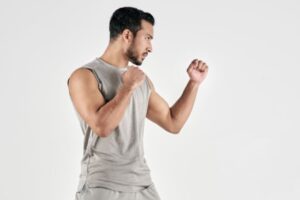
Fists suggest aggression; you indicate that you agree with the fight. They can make you look confrontational, which may escalate the situation, and they may limit your options in close quarters.
The open-hand stance allows you to use both hard and soft techniques.
De-escalation Is Part of Self-Defense
Many schools ignore verbal skills. But de-escalation is often the most important part of self-defense. If you can avoid a fight, you win.
Karate students should learn to:
- Use calm, firm language.
- Set verbal boundaries.
- Maintain space.
- Keep hands visible but ready.
This approach is more realistic than assuming every encounter becomes a fight. It reflects how violence actually starts: through arguments, threats, posturing, and sudden escalation.
Dirty Tricks Work
Techniques like eye gouges, groin slaps, bites, spits, and throat strikes are not part of sports karate, but they work. That’s why they’re banned in competition. But in real life, they can end a fight quickly.
Traditional karate includes many of these methods. Among other techniques, you’ll find:
- Nukite (spear hand) to the eyes or throat.
- Teisho (palm heel) under the chin or to the nose.
- Kakato geri (heel stomp) to the knee or foot.
- Kansetsu waza (joint attacks) to break or control.
They’re not flashy or tournament-winning, but they stop attackers.
These techniques often appear in kata. When interpreted properly, they reveal a brutal, efficient system for survival, but they must be trained safely and realistically.
Pressure Drills
To prepare for violence, training must include pressure. That means:
- Resistance from partners.
- Multiple attackers or unknown attacks.
- Low-light or confined-space scenarios.
- Verbal conflict before physical contact.
Drills should begin slowly and be controlled, allowing for proper technique and understanding. However, over time, they must become unpredictable to mimic real situations. The goal isn’t perfect execution but survival. Messy, quick, and effective responses are what truly matter.
Useful drills include:
- Grabbing and escaping under time pressure.
- Clinch fighting with limited strikes.
- Pad work with verbal pressure and interruption.
- Kata-based flow drills with random entry points.
Historical Context
Okinawan karate was not originally taught in large public dojos. It was a private method passed from teacher to student. Its purpose was to deal with local violence, grabs, brawls, and surprise attacks.
Old-style training included:
- Impact training with makiwara.
- Two-person drills for escape and control.
- Vital point targeting.
- Clinch and throw techniques.
Many of these elements were reduced or removed when karate entered schools and sports organizations. The roots are still there, but they require effort to uncover.
You don’t need to change style. You need to change your approach. If the goal is self-protection, training must reflect that reality. Not just in theory, but in practice, every class, every drill, every kata.
Final Thoughts
Karate still contains all the tools needed for effective self-defense. But it depends on how it’s trained. Techniques from kata, when applied under pressure and with context, can prepare you for real violence. Sport has its place, but if your goal is survival, training must reflect that goal: no rules, no scripts, just honest functional practice.
Thanks for reading.
Cheers, Gert