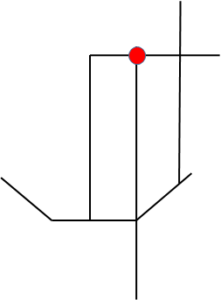
 Rules about the Embusen (Line of movement).
First, we need to define the term “Kiten”. Wikipedia says: .. “Nearly all Japanese-influenced Kata start and end on exactly the same Embusen point (Kiten)”.
We conclude that the Kiten is the starting and ending point of the Kata. … Great!
However, was it originally the intention that Kata should start and end in the same spot?
In recent times, and especially within sport karate, there are most often rules about the Embusen. You can read on Wikipedia; “Japanese Kata are mostly arranged to start and end on or around the same point. Many were modified from their original Okinawan versions to accomplish this feat. The purpose of this is simply to allow the movements to be practiced in a small training space. The rule of Embusen is that any movements in one direction should be symmetrical and countered by an equivalent number of movements in the opposite direction. In Okinawan karate, the maximum number of steps in any direction is normally three. “
“.. Kata are mostly arranged to start and end on or around the same point”.
That a Kata should start and end in the same place was mentioned in the book Karate-Do Kyohan by Gichin Funakoshi. It was also mentioned by Funakoshi’s student Nakayama (founder of JKA Shotokan) in the book Best Karate Vol 1, but beyond this, I have not been able to find information that can confirm this.
Gichin Funakoshi writes: (Karate-Do Kyohan 1973, Page 41)
“Whatever goes must come back”: in karate, the points at which one starts and completes the kata must coincide, and failure in this indicates either that an incorrect step has been taken or that variation in the lengths of stride has caused deviation from the correct positions.
Masatoshi Nakayama writes: (Best Karate Vol 1, Page 94)
The first movement of the kata and the last movement must be executed at the same point on the performance line.
Let us look at the creation of Kata.
The evolution of Kata unfolded across various times and locations, shaped by diverse individuals throughout history. The notion that masters from different eras and regions unanimously agreed on a Kata’s initiation and conclusion occurring at the same spot seems quite implausible to me. There were no explicit rules dictating that a Kata must commence and conclude at a fixed point.
I am sure that the creation of Kata was to remember the techniques, landing in the same place or not was probably not the primary goal. One must also keep in mind that times were different; at the time Kata where created. It was not about using Kata for competition purposes, but about techniques to be remembered in connection with self-defense and survival. The cosmetic has certainly not been a deciding factor.
The simple fact is that the Chinese forms were changed by the local Karate masters, in connection with their introduction to Okinawa.
Concerning the Chinese roots of Karate, it is very reasonable to believe that the requirement to start and end a Kata in the same place is a modification that has happened over time.
Itosu made changes to the Kata at the introduction to the Okinawan school around 1900. Later, Funakoshi modified the Kata again in connection with the introduction of Karate to the Japanese mainland.
It’s not really that strange that Kata has changed over time. All masters of the time who have been in contact with the Kata have, before passing them on to their students, more or less certainly tried to make their mark on Kata, and this may also have contributed to some loss of techniques. Furthermore, some techniques have been changed and perhaps replaced with new techniques associated with modifying Kata.
Try to review your Kata yourself to see if you land 100% in the same place. Take Naihanchi Shodan (Tekki Shodan), here you will land approx. one foot wide to the right when Kata ends.
We have to conclude that some Kata ends in the same place where they started, others do not, and some even end a whole step or more from the starting point, and that is just the way it is! Take Chinte, this form ends with three jumps backward just to end up in the same spot (Shotokan). I think that those three jumps are a cosmetic thing. In some Karate styles, the last three jumps in Chinte have been replaced by other techniques, thus returning to the starting position. In my version of Chinte, there are not three jumps; still, I almost land on the same spot, and no techniques have been added; as far as I know.
If you look at Karate as self-defense and a grabbing art, the Kiten is not important. I believe that visualizing the techniques is far more important. Ending your Kata at the same spot where you started is secondary and of less importance. Maybe not important at all.
“In Okinawan karate, the maximum number of steps in any direction is normally three “
Within our Karate, it is also normal that three steps apply. I think it has to do with space, as well as the changes a Kata has undergone since they were mixed with local combat systems on Okinawa. Furthermore, such a change will also mean that you land pretty much the same place where you started in your Kata.
At one point, I read an interview with Hirokazu Kanazawa, where he stated the following about the start and endpoint (Kiten) in a Kata. Unfortunately, I cannot find the source of this anymore. Maybe someone can help!
Hirokazu Kanazawa interview:
It is also true that three steps forward and three steps back help return the form to the same place where one started his Kata. Originally, a Kata did not land where it started. This is a modern concept.
My concluding comment:
The meaning of Kata is solely for remembering the aspects of self-defense techniques, ending up at the same place as you started is definitely a modern phenomenon, and probably stems from the Shotokan style. Over time, this idea has spread to other styles.
Thanks for reading.
Gert